On Lake Geneva, the Explora Journeys Swiss SailGP Team returns to fly higher

On 19 and 20 September, Geneva’s lakefront becomes the stage for the world’s best sailing athletes.
13 national teams, spectacular F50s racing at over 100 km/h, and among them, a Swiss team returning to where it all began for many of its athletes: Lake Geneva. Sébastien Schneiter, Arnaud Psarofaghis, Maud Jayet, Arno de Planta, Bryan Mettraux and Nils Theuninck: before racing around the world, they learned to read the wind here.
From a landlocked country, a generation raised on the shores of a lake has risen to compete among the very best.
This weekend, they return to Geneva with one simple ambition: to win in front of their home crowd.

A team arriving in Geneva with a newfound confidence
Over the past few months, the Swiss team has taken a significant step forward.
After an inconsistent start to the season, the team has steadily closed the gap to the frontrunner.
Third in Halifax, they secured their first podium of the season and qualified for the first four-boat Final in SailGP history. They backed it up in Portsmouth by reaching a second consecutive Final, finishing fourth. In Valencia in early September, they finished just four points short of another Final qualification.
The difference can be seen in the results, but it is felt even more on board.

We have the opportunity to compete against some incredibly strong teams and, over the past few months, we’ve really taken a step forward. We’re more consistent now and, with the energy of the home crowd in Geneva, we have a real chance of winning our first Sail Grand Prix at home.
Sébastien SchneiterDriver, Explora Journeys Swiss SailGP Team
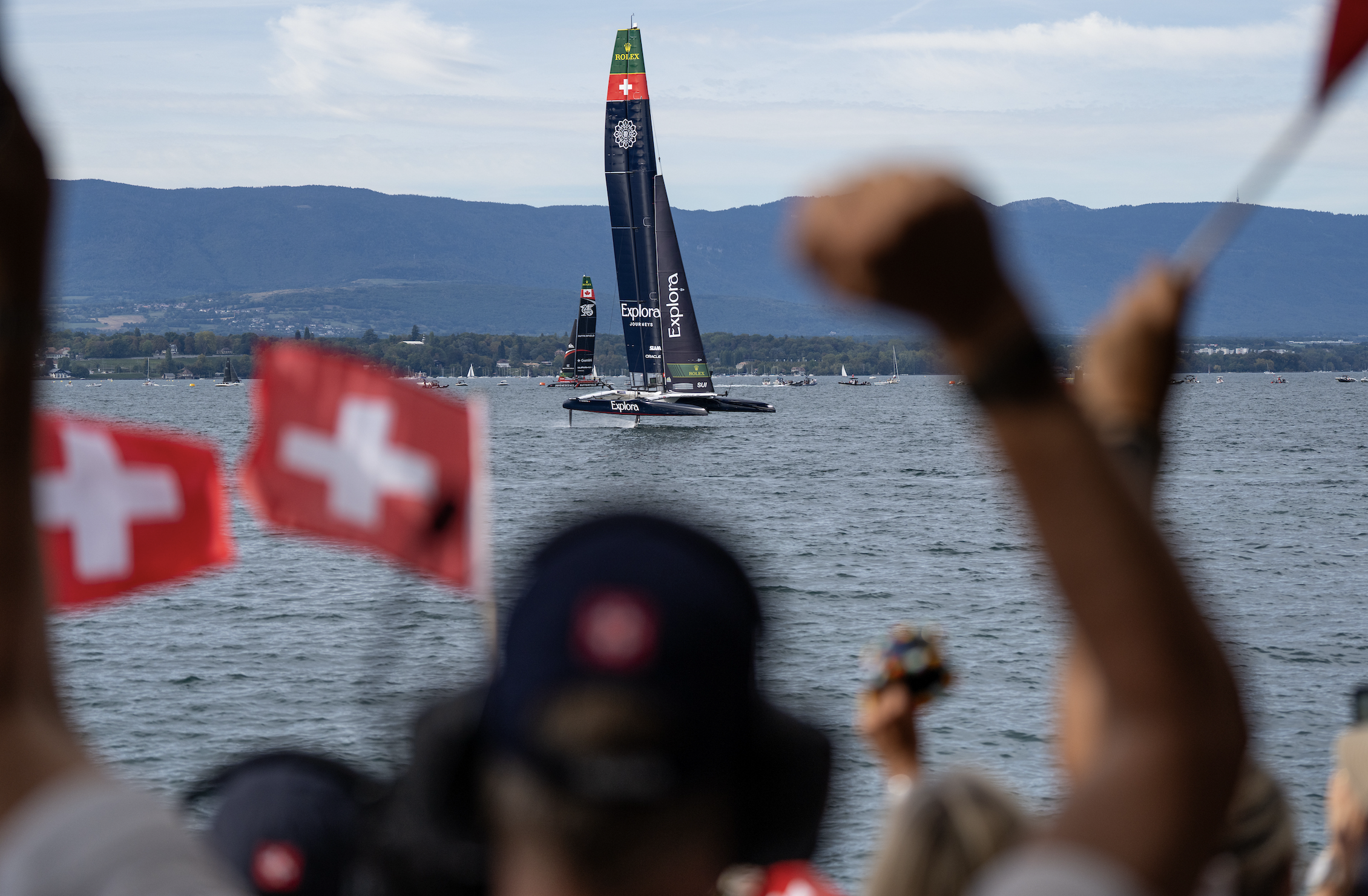
Make some noise with your cowbells!
There is nothing like racing at home.
Last year, the Swiss athletes discovered it for the first time: from the F50, they can hear the crowd. Even at full speed, focused on their manoeuvres and surrounded by the noise of the wind and the boat, the crew can hear the cheers coming from the shore.
And especially the cowbells.
So this year, the team has one very Swiss request for its home crowd:
Bring your cowbells!
We can hear you from the boat and it makes a difference.
From the waterfront, the grandstands or out on the water, the idea is simple: make sure the six athletes can feel their home crowd behind them.
Abroad, they represent Switzerland.
In Geneva, they race in front of it.
A sporting event with an impact on the city and its global reach

The first Geneva edition, in September 2025, went far beyond the sporting competition itself.
The event sold out and attracted a largely new and young audience: 90% of spectators were experiencing SailGP for the first time, and four out of five attendees were aged 44 or younger. The Swiss team finished third, in front of their home crowd.
The impact also extended well beyond the waterfront.
According to the Canton and City of Geneva, the economic impact of the inaugural edition was estimated at more than CHF 7 million. Geneva’s authorities cited the event’s tourism and economic benefits among the reasons for supporting its return in 2026.
The 2025 event also generated 8,120 media mentions and nearly 7 million media views, according to SailGP’s post-event report. The Canton of Geneva also reported that the event was watched by 19.5 million viewers internationally.
For a competition making its debut in Switzerland, the message was clear:
Geneva didn’t just host SailGP it took it to heart.

A competition where money can’t buy a faster boat
For partners, investors and business observers, one aspect of the SailGP model is essential: every team races the same F50.
The boats are owned by the league, technical developments are applied across the entire fleet, and performance data is shared.
A team can invest in its talent, training, analysis and preparation. It cannot simply commission a fundamentally faster boat than its competitors.
Technology therefore creates a level playing field.
Within that framework, value is created through execution: the quality of the athletes, decision-making, preparation, the ability to learn faster and to perform as one team.
The ambition for 2026 is now to go further in sporting performance, but also in attendance, audience and international visibility for Geneva.

What I like about this championship is that technology creates a level playing field. We all have access to the same boat. You can’t solve a performance problem simply by building a faster machine. You have to build a better team. For us, that’s where the value lies: in talent, preparation, data and the ability to improve together. And a race like Geneva also shows that an international sporting event can have a very tangible impact on the local economy.
Boet BrinkgreveCEO, Explora Journeys Swiss SailGP Team

Where sailing becomes flight
Then there is perhaps the most immediate reason to come and see them.
The F50s are beautiful.
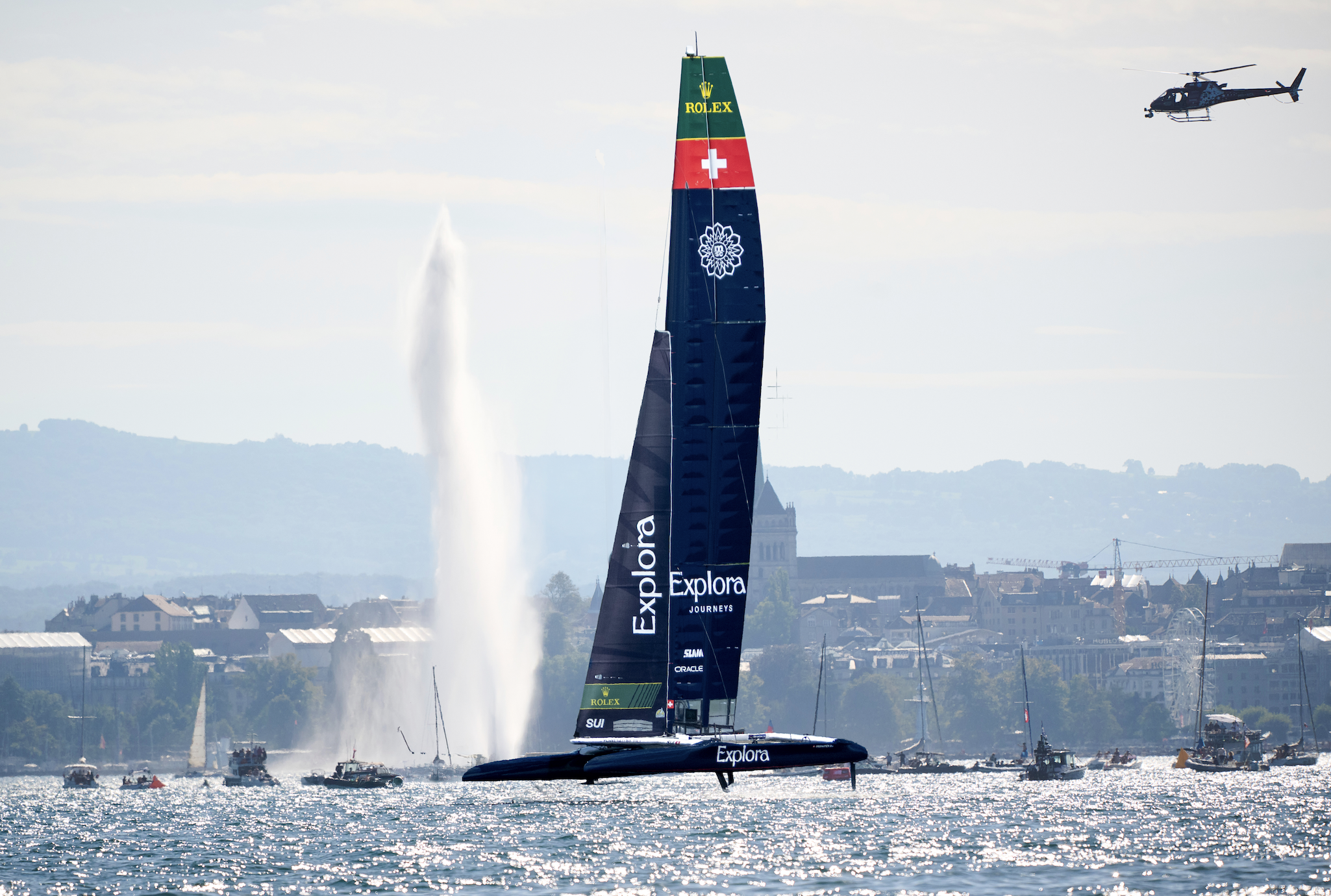
15 metres long and almost nine metres wide, built primarily from composite materials, they look more like aerospace prototypes than traditional sailing boats.
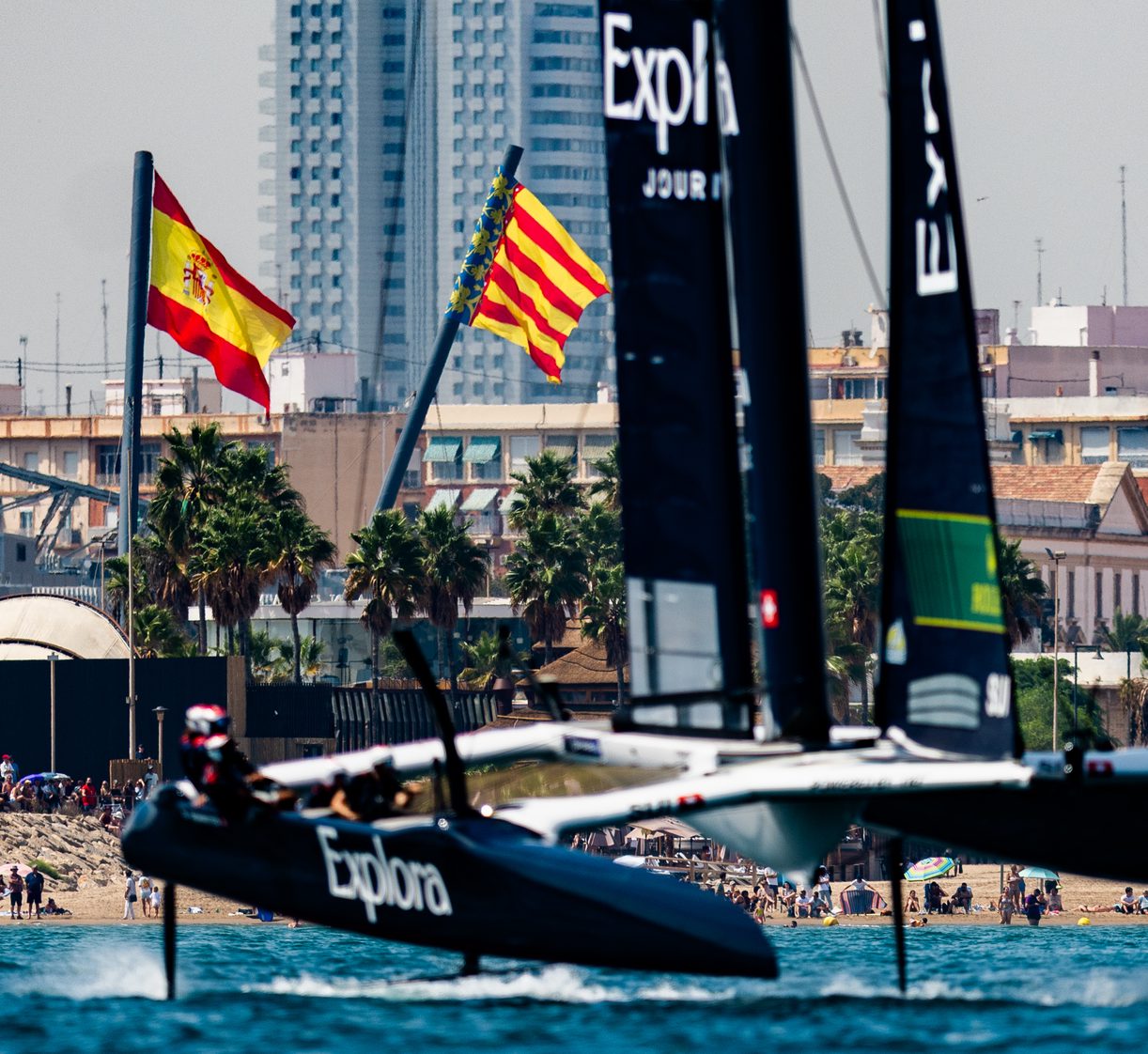
A towering rigid wing replaces the conventional mainsail. Beneath the hulls, foils act like underwater wings: as speed builds, they generate lift, gradually raising the boat until its hulls are almost entirely clear of the water.
At that point, the F50 is no longer really sailing on Lake Geneva.
It is flying above it.
The sight is unmistakable, even to someone who knows nothing about sailing: two hulls suspended above the water, only a few points still touching the surface, and a 15-metre machine capable of exceeding 100 km/h.
The current racing speed record stands at 107.63 km/h.
In Geneva, these boats will fly just a few hundred meters from the crowds.

A machine driven by data, but won by people
Behind the visual simplicity of a boat in flight lies an extraordinary amount of technology.
The F50 is equipped with sensors that continuously record the boat’s performance. Speed, angles, settings, trajectory, foil behavior, tactical decisions: teams have access to a wealth of data that allows them to analyse almost every second on the water.
Analysis is part of the team’s daily work.
But here again, every team has access to the same tools.

We can analyse almost everything: a start, a manoeuvre, an angle, a few seconds lost between two decisions. The amount of data available is quite extraordinary. And the boat itself is a magnificent machine: when it rises onto the foils and the hulls lift out of the water, you really feel the engineering behind it. But everyone has the same F50 and access to the same information. The machine enables performance; it doesn’t guarantee it. In the end, it is always the people on board, and the way they work together, that make the difference.
Maud JayetStrategist, Explora Journeys Swiss SailGP Team
It is this contrast that makes the F50s so unique.
They are extraordinarily sophisticated, yet their performance depends on human decisions made in fractions of a second. Engineered with precision, driven by data and fine-tuned down to the smallest detail, once the race begins, six athletes must turn all that technology into speed.
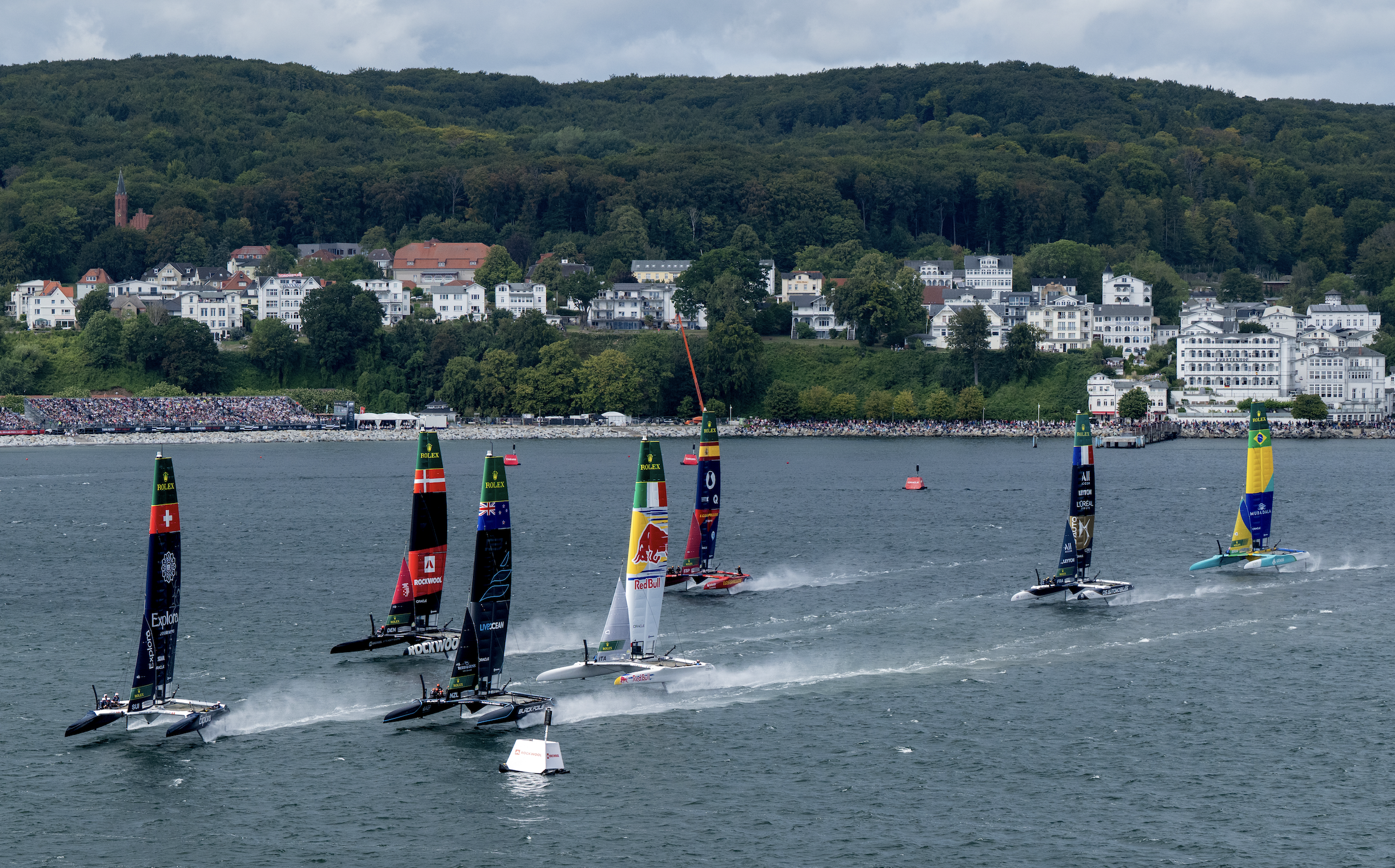
For the public, the image is much simpler: 13 boats flying across Geneva’s lakefront.
And on one of them, a team that has known these waters since long before SailGP.

A collective ambition
Since 2021, the team has carried the Swiss colours around the world.
More than its colours, the team carries Swiss values and a culture built on excellence, talent development, fair play and the ability to build lasting performance. It is also what connects the team so naturally with its title partner, Explora Journeys.
Two worlds where excellence never comes down to one individual, but to the precision of a collective.
Anna Nash, President of Explora Journeys, expressed it when the partnership was announced:
“What resonates for us is the Swiss team itself: the way the crew comes together to operate as one, combining instinct, trust and technical mastery to drive performance on the water.”
It is a philosophy she also sees reflected in the crews aboard Explora Journeys’ ships, where teamwork, discipline and trust define the experience.
This weekend, there will be competition: speed, flying boats, spectacular starts, close duels and the extraordinary feeling of watching Formula 1 on water.
But beyond the spectacle are athletes determined to demonstrate what collective performance and respect for their competitors look like at the highest level.
And when they take to the water, they do so to win.

The athletes of the Explora Journeys Swiss SailGP Team
Sébastien Schneiter
Driver, Geneva (GE)
At the helm of the F50, he steers the boat and determines its course. Born in Geneva and trained on Lake Geneva at the Société Nautique de Genève, he is a three-time Olympian and is preparing for Los Angeles 2028 alongside Arno de Planta.
Maud Jayet
Strategist, Lausanne (VD)
She reads the wind, watches the competition and helps guide tactical decisions: a particularly important role on Lake Geneva, known for its shifting winds. Born in Lausanne and a member of the Société Nautique de Genève, she is a two-time Olympian.
Arnaud Psarofaghis
Wing Trimmer, Corsier (GE)
He controls the rigid wing that powers the F50. Trained on Lake Geneva, a Bol d’Or winner and former member of Alinghi Red Bull Racing, he brings extensive experience in high-performance multihull racing.
Bryan Mettraux
Flight Controller, Genève (GE)
He controls the foils that allow the F50 to fly and keeps the boat stable at very high speeds. Born in Geneva and a two-time GC32 World Champion, he also competed in the 37th America’s Cup with Alinghi Red Bull Racing.
Matt Gotrel
Grinder, Cheltenham (England)
An Olympic rowing champion at Rio 2016, the Briton has competed in SailGP since its inaugural season in 2019. After several seasons with the British team and a spectacular accident in Sydney in 2023, he joined the Swiss team for the 2025 season, returning to competition aboard the F50.
Arno de Planta
Grinder, Pully (VD)
Born in Pully, he and Schneiter have formed a longstanding partnership: together, they became 49er World Championship silver medallists in 2023 before finishing eighth at the Paris 2024 Olympic Games. Now a Grinder aboard the Swiss F50, he continues his Los Angeles 2028 campaign alongside Schneiter.
Nils Theuninck
Reserve Athlete, Pully (VD)
Born in Pully, a former world No. 1 in the Finn class and GC32 World Champion in 2018, he also competed in the 37th America’s Cup as a cyclor with Alinghi Red Bull Racing. He joined the Swiss SailGP squad in 2026 as a Reserve Athlete.